Example settings
Each still links to the exact settings that produced it — click one to land in the
controls with that state loaded.
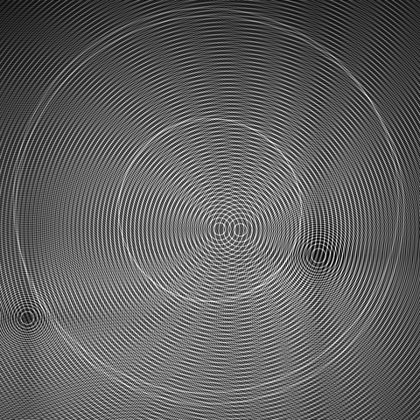 ring lattice, wide
Ten stars, rings only, no normalisation. The densest interference lattice the sweep produced.
/moire2/field/2026-12-31?extent=9.2951&depth=0.0000&yaw=2.5939&pitch=-0.2758&count=10&waveSpeed=17.01&decay=52.3&ringSpeed=8.66&field=0&rings=1&norm=0&surface=plane&anchor=Sun&freq=rotation
ring lattice, wide
Ten stars, rings only, no normalisation. The densest interference lattice the sweep produced.
/moire2/field/2026-12-31?extent=9.2951&depth=0.0000&yaw=2.5939&pitch=-0.2758&count=10&waveSpeed=17.01&decay=52.3&ringSpeed=8.66&field=0&rings=1&norm=0&surface=plane&anchor=Sun&freq=rotation
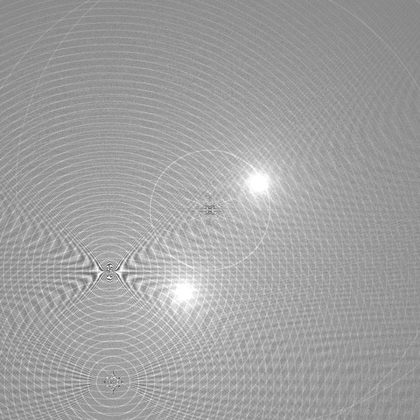 inner solar system
Zoomed to 1.8 AU with low decay: the field resolves into radial bursts around each body.
/moire2/field/2026-12-31?extent=1.7477&depth=0.0000&yaw=-2.2222&pitch=0.0000&count=9&waveSpeed=7.64&decay=24.4&ringSpeed=0.64&field=1&rings=1&norm=1&surface=plane&anchor=Sun&freq=legacy
inner solar system
Zoomed to 1.8 AU with low decay: the field resolves into radial bursts around each body.
/moire2/field/2026-12-31?extent=1.7477&depth=0.0000&yaw=-2.2222&pitch=0.0000&count=9&waveSpeed=7.64&decay=24.4&ringSpeed=0.64&field=1&rings=1&norm=1&surface=plane&anchor=Sun&freq=legacy
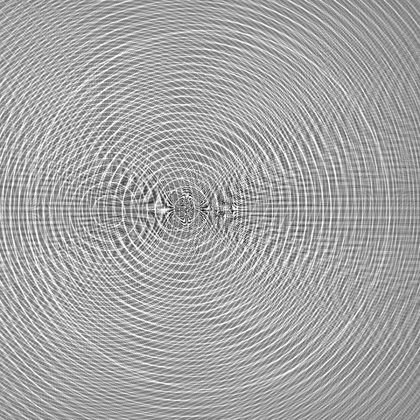 planets, mid zoom
Nine bodies at 8.8 AU. Low decay keeps the near-field structure sharp.
/moire2/field/2026-12-31?extent=8.8338&depth=0.5620&yaw=-1.6258&pitch=-1.3859&count=9&waveSpeed=27.83&decay=17.2&ringSpeed=17.07&field=1&rings=1&norm=0&surface=plane&anchor=Sun&freq=rotation
planets, mid zoom
Nine bodies at 8.8 AU. Low decay keeps the near-field structure sharp.
/moire2/field/2026-12-31?extent=8.8338&depth=0.5620&yaw=-1.6258&pitch=-1.3859&count=9&waveSpeed=27.83&decay=17.2&ringSpeed=17.07&field=1&rings=1&norm=0&surface=plane&anchor=Sun&freq=rotation
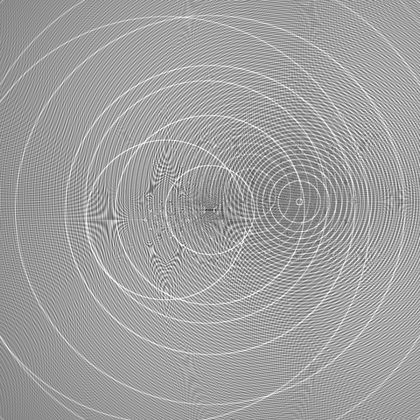 planets, tight
Five bodies at 1.4 AU — the smallest useful scale before a single body dominates.
/moire2/field/2026-12-31?extent=1.4518&depth=0.0000&yaw=0.5786&pitch=1.4327&count=5&waveSpeed=2.11&decay=21.8&ringSpeed=4.22&field=1&rings=1&norm=0&surface=plane&anchor=Sun&freq=rotation
planets, tight
Five bodies at 1.4 AU — the smallest useful scale before a single body dominates.
/moire2/field/2026-12-31?extent=1.4518&depth=0.0000&yaw=0.5786&pitch=1.4327&count=5&waveSpeed=2.11&decay=21.8&ringSpeed=4.22&field=1&rings=1&norm=0&surface=plane&anchor=Sun&freq=rotation
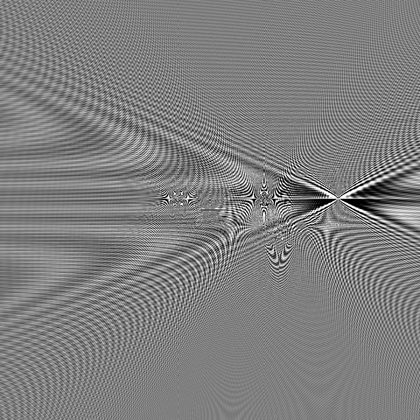 planets, high decay
Same region with decay 124: the field flattens and long-range interference takes over.
/moire2/field/2026-12-31?extent=2.6831&depth=0.0000&yaw=1.9213&pitch=-0.9592&count=10&waveSpeed=6.05&decay=124.3&ringSpeed=1.03&field=1&rings=0&norm=1&surface=plane&anchor=Sun&freq=rotation
planets, high decay
Same region with decay 124: the field flattens and long-range interference takes over.
/moire2/field/2026-12-31?extent=2.6831&depth=0.0000&yaw=1.9213&pitch=-0.9592&count=10&waveSpeed=6.05&decay=124.3&ringSpeed=1.03&field=1&rings=0&norm=1&surface=plane&anchor=Sun&freq=rotation
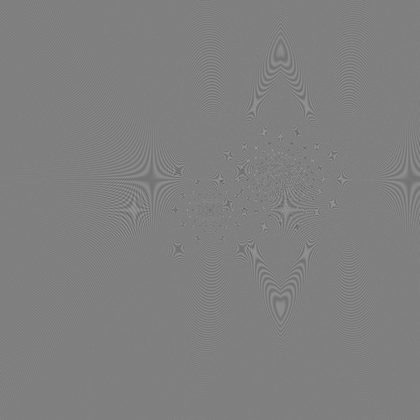 Earth-anchored
Anchored on Earth with two bodies: the plane locked to Earth's equator.
/moire2/field/2026-12-31?extent=1.1055&depth=-0.7337&yaw=-0.2879&pitch=0.0000&count=2&waveSpeed=12.49&decay=24.5&ringSpeed=0.55&field=1&rings=0&norm=1&surface=plane&anchor=Earth&freq=rotation
Earth-anchored
Anchored on Earth with two bodies: the plane locked to Earth's equator.
/moire2/field/2026-12-31?extent=1.1055&depth=-0.7337&yaw=-0.2879&pitch=0.0000&count=2&waveSpeed=12.49&decay=24.5&ringSpeed=0.55&field=1&rings=0&norm=1&surface=plane&anchor=Earth&freq=rotation
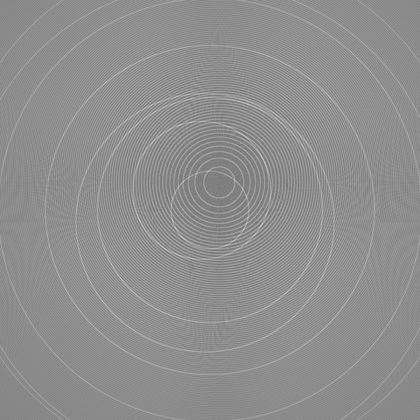 four bodies, decay 9
Very low decay concentrates everything into the near field.
/moire2/field/2026-12-31?extent=7.0927&depth=-3.7327&yaw=0.2237&pitch=0.0000&count=4&waveSpeed=8.91&decay=9.0&ringSpeed=3.42&field=1&rings=1&norm=1&surface=plane&anchor=Sun&freq=rotation
four bodies, decay 9
Very low decay concentrates everything into the near field.
/moire2/field/2026-12-31?extent=7.0927&depth=-3.7327&yaw=0.2237&pitch=0.0000&count=4&waveSpeed=8.91&decay=9.0&ringSpeed=3.42&field=1&rings=1&norm=1&surface=plane&anchor=Sun&freq=rotation
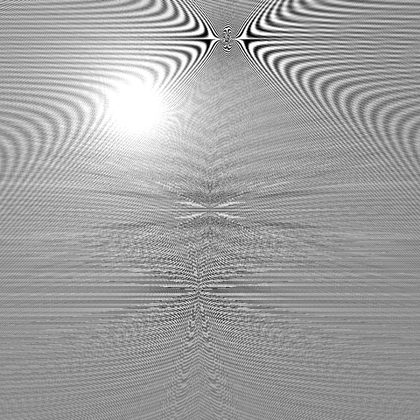 as /moire2
The reference point: the original frequency model, no ring layer, no amplitude normalisation.
/moire2/field/2026-12-31?freq=legacy&rings=0&norm=0&count=9
as /moire2
The reference point: the original frequency model, no ring layer, no amplitude normalisation.
/moire2/field/2026-12-31?freq=legacy&rings=0&norm=0&count=9
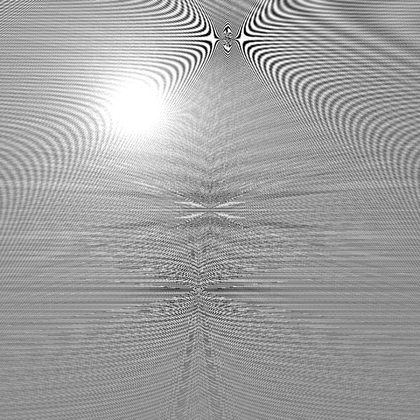 true 3D distance
Same settings, but every distance is now genuinely 3D. Off-ecliptic bodies sit further away and ripple wider.
/moire2/field/2026-12-31?freq=legacy&rings=0&norm=0&count=10
true 3D distance
Same settings, but every distance is now genuinely 3D. Off-ecliptic bodies sit further away and ripple wider.
/moire2/field/2026-12-31?freq=legacy&rings=0&norm=0&count=10
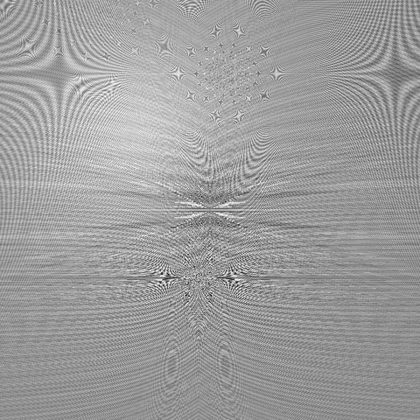 tilted off ecliptic
The cutting plane pitched 34° out of the ecliptic — the first view impossible in the flat version.
/moire2/field/2026-12-31?freq=legacy&rings=0&norm=0&count=10&pitch=0.6
tilted off ecliptic
The cutting plane pitched 34° out of the ecliptic — the first view impossible in the flat version.
/moire2/field/2026-12-31?freq=legacy&rings=0&norm=0&count=10&pitch=0.6
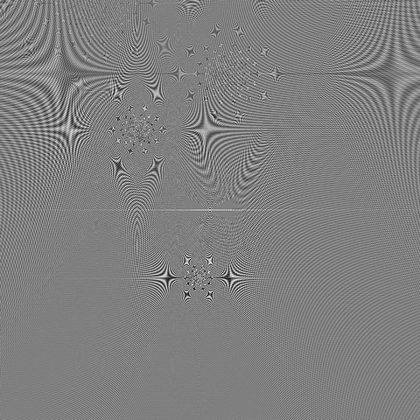 real rotation
Frequencies switched from the legacy hour values to real sidereal periods, matching how the stars are driven.
/moire2/field/2026-12-31?freq=rotation&rings=0&count=10&pitch=0.6
real rotation
Frequencies switched from the legacy hour values to real sidereal periods, matching how the stars are driven.
/moire2/field/2026-12-31?freq=rotation&rings=0&count=10&pitch=0.6
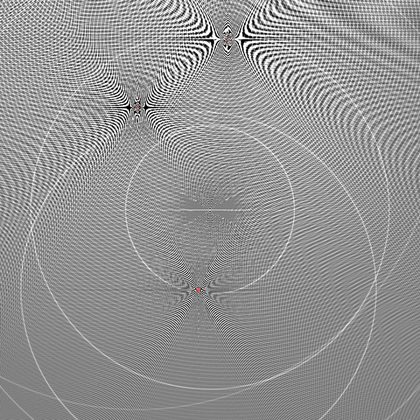 expanding fronts
The spherical wavefronts switched on. Where a front has not yet reached the plane, that body contributes nothing.
/moire2/field/2026-12-31?freq=rotation&rings=1&count=10&markers=1
expanding fronts
The spherical wavefronts switched on. Where a front has not yet reached the plane, that body contributes nothing.
/moire2/field/2026-12-31?freq=rotation&rings=1&count=10&markers=1
 off-plane slice
The plane slid along its own normal, away from the ecliptic. Marker rings grow as bodies fall off the surface.
/moire2/field/2026-12-31?freq=rotation&rings=1&count=10&depth=8&markers=1
off-plane slice
The plane slid along its own normal, away from the ecliptic. Marker rings grow as bodies fall off the surface.
/moire2/field/2026-12-31?freq=rotation&rings=1&count=10&depth=8&markers=1
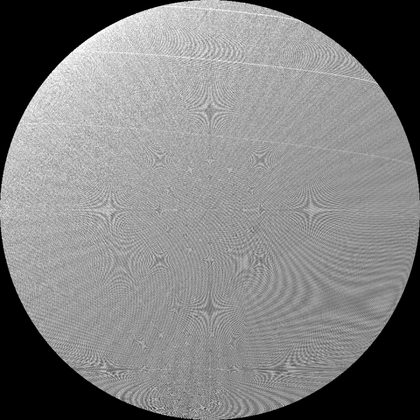 sphere surface
The registration surface is a sphere centred on the Sun rather than a plane.
/moire2/field/2026-12-31?surface=sphere&rings=1&count=10
sphere surface
The registration surface is a sphere centred on the Sun rather than a plane.
/moire2/field/2026-12-31?surface=sphere&rings=1&count=10
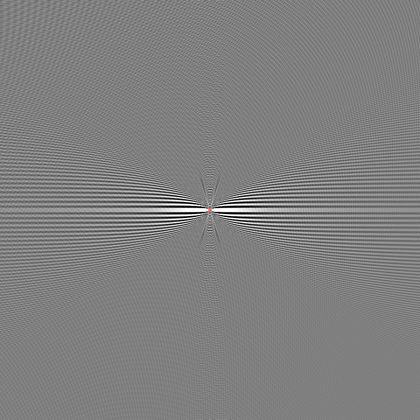 anchored on Jupiter
Origin moved to Jupiter and the plane locked to its equator via its IAU pole.
/moire2/field/2026-12-31?freq=rotation&rings=0&count=10&anchor=Jupiter&markers=1
anchored on Jupiter
Origin moved to Jupiter and the plane locked to its equator via its IAU pole.
/moire2/field/2026-12-31?freq=rotation&rings=0&count=10&anchor=Jupiter&markers=1